Will the Dust Bowl Happen Again
A devastating Dust Bowl rut wave is at present more than twice every bit likely, study says
The Bang-up Plains Dust Bowl of the 1930s was arguably the most devastating ecological disaster in American history, turning prairies into deserts and whipping upward killer dust storms. The catastrophe was partly manmade — driven past decades of country mismanagement — and fueled by brutal heat waves and years of relentless drought.
More than eight decades later, the summer of 1936 remains the hottest summertime on record in the U.South. However, new research finds that the heat waves that powered the Grit Basin are now 2.5 times more likely to happen again in our modern climate due to some other blazon of manmade crisis — climatic change.
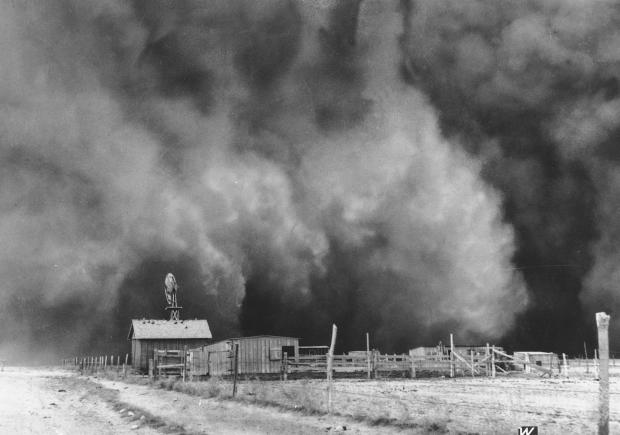
Even though information technology seemed like a natural disaster, the background for much of the suffering acquired by the Grit Bowl was laid by humans.
Until the belatedly 1800s the Corking Plains were covered by endless acres of native grasslands, well attuned to the unique climate of the region. That had all changed past the turn of the 20th century, equally a series of federal land acts enticed pioneers to motion to the region and ready farms with the promise of free or cheap land.
With cold winters, hot summers and a dry, windy climate, the surface area was considered marginal farmland. But with need from a growing wheat and cattle market, farms rapidly replaced deep-rooted grasslands, which normally helped to trap soil and wet even during droughts.
The decimation of native grasslands led to a significant loss of both soil moisture and the ability to keep soil in identify. It is estimated that three to iv inches of topsoil was blown away during the 1930s. To make matters worse, some relatively inexperienced farmers engaged in deep plowing of virgin topsoils and enabled overgrazing.
This absence of audio state management led to a feedback loop, where the lack of vegetation and moist soils meant the land no longer had the power to cool itself through evaporation. And then when natural climate fluctuations in the Atlantic and Pacific Oceans led to a streak of years with heat and drought in the Plains, the state not only had no buffer, simply actually acted to amplify the disaster.
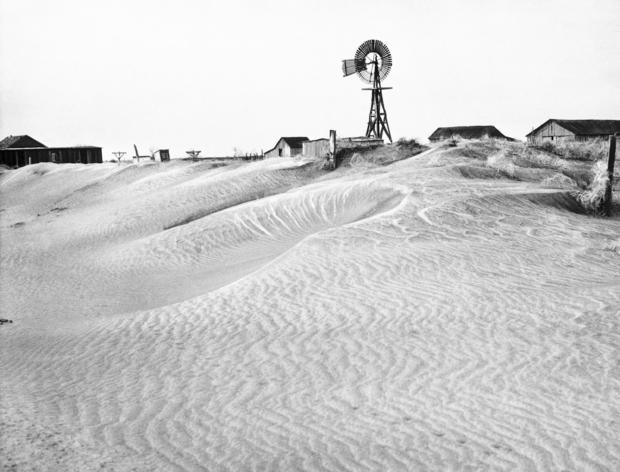
The authors of the study found that even fashion back then, emissions had already started to influence the climate. "These extremes occurred during a menses of multidecadal warming, with early twentieth century global-scale drought likely amplified past greenhouse gases," they write.
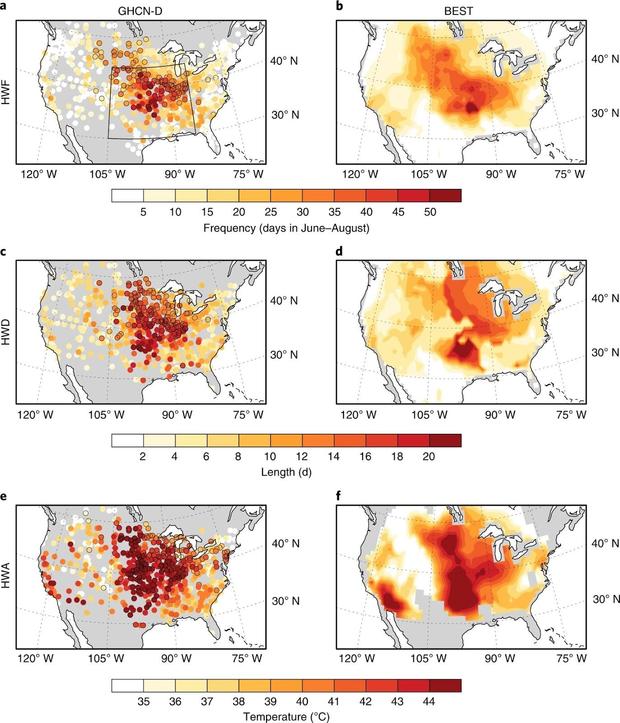
The 1936 rut wave was so farthermost information technology is considered a once-in-100-year event, with 25% of all U.S. daily estrus records set up during that summer and half of such records set up during the 1930s. Temperatures routinely topped 110 degrees Fahrenheit.
The images below evidence the area covered by the 1936 heat wave, and from superlative to bottom: the number of days with extreme heat, the length of the longest estrus wave stretch, and the hottest temperatures recorded.
When the Dust Bowl hitting, 24-hour interval turned into nighttime as biblical dust storms buried parts of roads and buildings, especially in parts of Kansas, Oklahoma and Texas. On "Black Sunday" in the Oklahoma Panhandle — April 14, 1935 — Thelmas Bemount Campbell described her terror to author Amy Dee Stephens as a dust storm enveloped her home:
"We could see information technology rolling toward us at a terrific speed like a prairie fire. The air current was and then potent that we heard later information technology had broken the wind gauges…When information technology hit, everything became very still and nosotros were enveloped in this terrible blackness. We couldn't see our hand in front of our face. Some people thought they had been struck blind."
As the dust storms became larger and more intense, children developed fatal "dust pneumonia" and business owners, already reeling from the Great Low, were devastated, some driven to suicide and others forced to flee with their families in a mass exodus. In total, the Dust Bowl killed around 7,000 people and left 2 million homeless.
The heat, drought and grit storms as well had a pour consequence on U.Southward. agriculture. Wheat production fell by 36% and maize production plummeted by 48% during the 1930s.
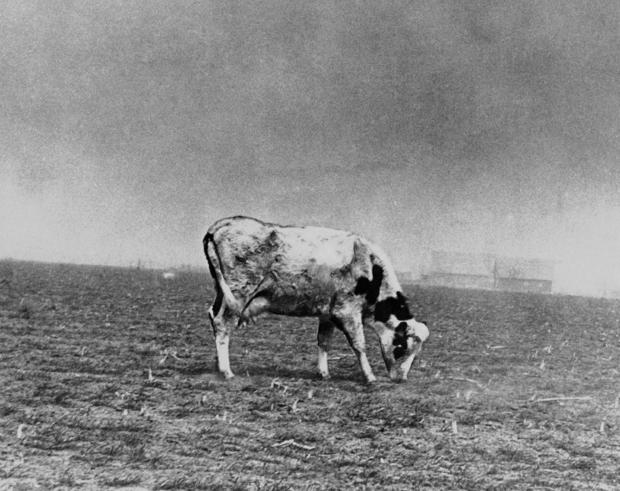
The Dust Basin is an example of an environmental disaster clearly made worse by the unintended consequences of human. And the study concludes that climate change may presently bring about the next ane: "Information technology is likely that the 1930s records will be broken in the almost-future fifty-fifty if there is action to mitigate emissions."
To go far at their determination, the researchers ran thousands of computer model simulations of the 1930s rut waves, but with atmospheric greenhouse gas concentrations at today's levels.
The study used a novel climate model developed at the University of Oxford that does not run on supercomputers, but rather on the personal computers of volunteers from around the globe. This technique suited their detail 1930s heat moving ridge investigation considering thousands of simulations could exist conducted for each Dust Basin year.
The simulations showed that as a result of rapidly increasing heat-trapping greenhouse gases, the 1-in-100-year 1936 heat wave is, at the very least, now more of a one-in-40-year event for the Swell Plains — significant a rut wave of that magnitude is now more twice as likely and could occur twice in the average person's lifetime.
Lead writer of the report Dr. Tim Cowan, of the University of Southern Queensland in Australia, cautions that even this 40-year return menses is likely an underestimate, and in the time to come extreme estrus waves will occur even more frequently.
Simply given the rise in greenhouse gases over many decades, CBS News asked Cowan why we haven't already seen a return of Dust Basin-like weather in the Great Plains. Cowan explains that the answers prevarication in the mod-day watering of crops. "Groundwater is used quite extensively across the U.S., and we know, from previous inquiry, that increased irrigation and agricultural intensification has led to cooler summertime maximum temperatures," he said.
But Cowan's work suggests that our luck will eventually run out, either when natural conditions and manmade climate change conspire to overwhelm the cooling influence of irrigation or when groundwater is sufficiently depleted.
In the western Great Plains the majority of groundwater comes from ane of the world's largest aquifers -- the Ogallala Aquifer, which runs from Nebraska to Texas. Simply in recent decades, water is being extracted much faster than information technology is being replenished. Well outputs in the central and southern parts of the aquifer are declining due to excessive pumping, and prolonged droughts have parched the area, bringing back Dust Bowl-style storms.
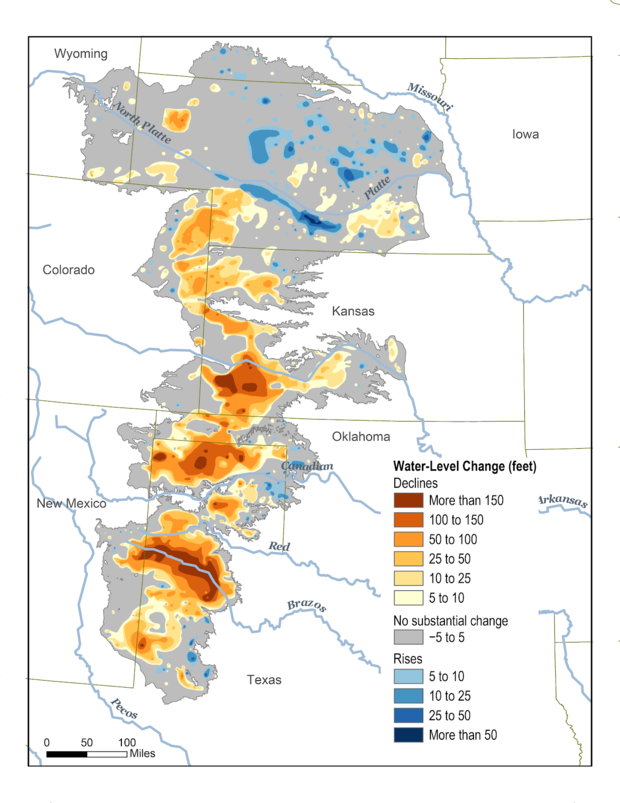
According to the federal authorities'south 2018 National Climate Assessment, parts of the Ogallala Aquifer should be considered a nonrenewable resource.
As a result, Cowan warns, "Dwindling water availability in regions of low groundwater recharge may hateful that cooler summertime weather may switch to warmer temperatures in decades to come up under the influence of rising greenhouse gas emissions."
If these Dust Bowl weather condition do return, scientists say nosotros should prepare for a shock to the food system. A recent study predicted that the U.South. would exhaust 94% of its wheat reserves in a four-year Grit Bowl-like event. This would lead to a 31% loss of global wheat stocks.
Besides the impacts on food systems, an April study from the University of Washington finds the expected increase in farthermost heat will besides exist a wellness shock. The inquiry warns of danger for agronomical pickers in the U.S., with unsafe work days more than doubling by 2050 and oestrus waves happening five times more often every bit the planet continues to warm.
The bottom line, Cowan says: "It is likely that there volition exist more extreme rut wave conditions in the central U.Due south. in the future, given the ascent in greenhouse gases levels, so communities and governments need to be prepared for this eventuality."
Source: https://www.cbsnews.com/news/dust-bowl-heat-wave-climate-change-twice-as-likely-study-says/
0 Response to "Will the Dust Bowl Happen Again"
Post a Comment